

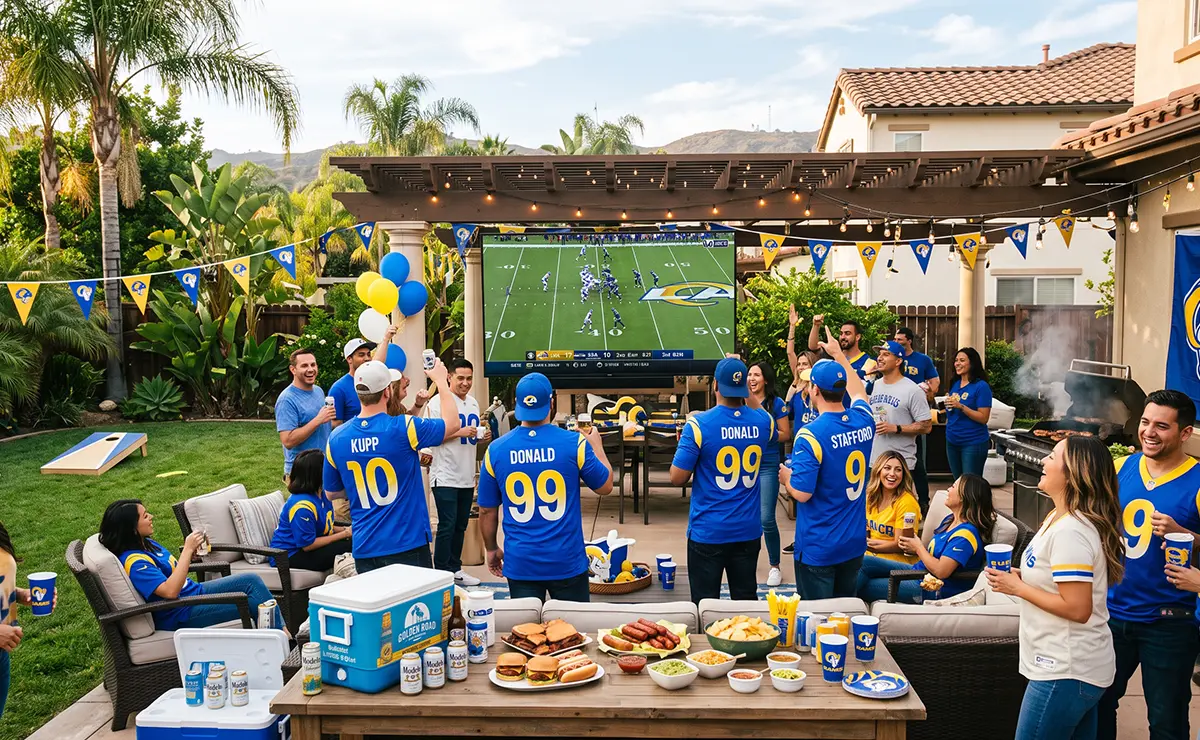
Southern California was built for outdoor entertaining.
With the right setup, your backyard instantly becomes prime real estate for every kickoff, tip-off, and final inning. From choosing the perfect screen to refining your layout, here’s everything you need to build the ultimate game day lounge.
What Do You Need for an Outdoor Game Day Setup?
- Space: How much square footage do you have? Even a modest patio can work.
- Power access: Are outlets nearby, or will you need an extension cord or outdoor power station?
- Sun and shade: Afternoon sun can wash out screens. Know which direction your yard faces.
- Neighbors: Sound carries. Think about speaker placement and volume limits.
How to Choose the Right Screen for Outdoor Viewing
Your screen is the centerpiece of the whole setup. Two options work well outdoors:
Outdoor TV
- Built to withstand heat, moisture, and direct sunlight
- Higher brightness (measured in nits) for daytime visibility
- More expensive upfront, but durable long-term
- Best for: patios with partial shade and a fixed viewing area
Projector + Screen
- More affordable entry point
- Better for larger images (100″+ viewing experience)
- Requires darkness or shade to look good
- Best for: evening games or yards with overhead shade structures
Quick tips:
- Look for a minimum brightness of 1,000 nits for outdoor TVs used in partial sunlight
- For projectors, a gain of 1.0–1.3 works well for most backyard setups
- Mount your screen at eye level when seated, roughly 42–48 inches from the ground to the center of the screen
How Should You Arrange Seating for an Outdoor Viewing Area?
Comfort keeps guests hooked. Here’s how to nail the layout:
- Front row: Low-profile lounge chairs or outdoor sofas with cushions
- Back row: Bar stools or raised folding chairs so everyone gets a clear sightline
- Side seats: Angled ottomans or Adirondack chairs for overflow guests
- Leave room: Allow at least 3 feet between rows so people can move freely
Materials that hold up in SoCal heat:
- Powder-coated aluminum (rust-resistant, lightweight)
- Teak or eucalyptus wood (naturally weather-resistant)
- Solution-dyed acrylic fabric cushions (fade-resistant, easy to clean)
Avoid cheap foam cushions—they absorb moisture and break down fast in UV-intense climates.
What Lighting Works Best for Outdoor Game Day Lounges?
Lighting serves two purposes: ambiance and visibility. Get both right with this layered approach:
- String lights: Hang overhead in a grid or zigzag pattern for warm, even ambient light
- Path lights: Line walkways and seating edges so guests don’t trip after dark
- Bias lighting: Place LED strips behind your TV or screen to reduce eye strain during night games
- Smart bulbs: Use color-changing smart lights (like Philips Hue Outdoor) to match your team’s colors on game day
Stick to warm white (2700K–3000K) for general lighting and save the color LEDs for accent zones.
How Do You Get Great Sound Outdoors?
Sound dissipates fast outside. A standard Bluetooth speaker won’t cut it for a crowd. Here’s what works:
- Outdoor bookshelf speakers: Mount them on a fence or pergola post, aimed at the seating area
- Soundbar with outdoor rating: Some brands like Sonos and Polk Audio make weatherproof options
- Subwoofer placement: Set it near the base of your screen or under a table—bass carries well on its own
Sound tips:
- Aim speakers slightly downward toward the audience
- Keep volume balanced across speakers to prevent hot spots
- Consider a simple AV receiver if you’re running multiple speakers
What Should You Include in a Backyard Snack & Drink Station?
A great snack station keeps guests happily outdoors:
- Rolling bar cart: Doubles as a drink station and can be moved out of the way after the game
- Cooler with wheels: Load it with drinks before kickoff so you’re not running back and forth
- Folding table: Set up chips, dips, and finger foods within easy reach of the seating area
- Mini outdoor fridge: If you entertain often, a weatherproof mini fridge is worth the investment
Keep condiments, napkins, and utensils in a small caddy on the table. Fewer trips inside = more game time.
How Can You Protect Your Outdoor Setup Between Games?
Southern California weather is mild, but UV rays, marine layer moisture (especially near the coast), and the occasional Santa Ana wind can damage your gear.
- TV cover: Use a fitted, weatherproof cover when the TV isn’t in use
- Furniture covers: Heavy-duty polyester covers protect cushions and frames overnight
- Cable management: Run cords through weatherproof conduit or use outdoor-rated extension cords
- Surge protector: An outdoor-rated surge protector shields your electronics from power spikes
A little protection goes a long way, especially for electronics left outside year-round.
Finishing Touches That Elevate Your Outdoor Lounge
The basics get your setup functional. These extras make it memorable:
- Outdoor rug: Defines the space and adds comfort underfoot
- Pergola or shade sail: Cuts glare and keeps things cooler during afternoon games
- Team decor: Banners, colored throw pillows, and team flags add personality
- Fire pit or patio heater: Useful for evening games in cooler months or at higher elevations
- Outdoor projector shelf: A wall-mounted shelf keeps your projector stable and at the right angle
Build It Once, Enjoy It All Season
The best backyard game day lounges don’t require a full renovation. Start with your screen and seating, then layer in sound, lighting, and extras over time.
With Southern California’s near year-round outdoor season, the investment pays off fast. A setup that costs a few hundred dollars in DIY effort can replace dozens of trips to crowded sports bars — and it’s a lot more comfortable for everyone.
FAQs: Creating an Outdoor Viewing Lounge
Q: What’s the best outdoor TV for a sunny backyard in Southern California?
Look for an outdoor TV with at least 1,000 nits of brightness for partially shaded areas and 2,000+ nits for full-sun exposure. Brands like SunBrite and Samsung Terrace are designed specifically for outdoor use and handle UV exposure well. Avoid bringing a standard indoor TV outside—it will overheat and the screen will wash out in daylight.
Q: Can I use a regular indoor projector outside?
A standard indoor projector can work outdoors at night with low ambient light, but it won’t perform well in daylight or in the shade. For better results, use a short-throw or high-lumen outdoor projector (3,000+ lumens) paired with a gain screen that reflects light toward the audience.
Q: How much does it cost to set up an outdoor game day lounge?
A basic setup — projector, folding screen, a few chairs, and a Bluetooth speaker — can cost as little as $300–$500. A mid-range setup with an outdoor TV, quality seating, and weatherproof speakers typically runs $1,500–$3,000. A premium permanent installation with a pergola, outdoor AV system, and built-in bar can exceed $10,000.
Q: What’s the best way to run power to an outdoor TV or projector?
The safest approach is to use a GFCI-protected outdoor outlet. If you don’t have one near your viewing area, hire a licensed electrician to install one. It’s a relatively affordable upgrade. Avoid permanently running indoor extension cords outside, as they’re not rated for weather exposure and can pose a fire hazard.
Q: How do I reduce screen glare during afternoon games?
Shade is your best tool. A shade sail, pergola, or patio umbrella positioned to block the sun’s angle makes a significant difference. You can also use an anti-glare screen protector on your outdoor TV. Positioning the screen so it faces north or east also limits direct sun exposure during afternoon hours.
Q: What type of outdoor seating holds up best in Southern California heat?
Powder-coated aluminum frames and solution-dyed acrylic cushions perform best in SoCal’s UV-heavy climate. Teak and eucalyptus wood are also durable choices that age well without cracking. Avoid dark synthetic wicker and cheap plastic frames. They tend to fade, crack, and warp faster under consistent sun exposure.
Q: Do I need a permit to build a pergola or shade structure for my outdoor lounge?
In most Southern California cities, freestanding pergolas under a certain size (often 200 square feet) don’t require a permit. Attached structures or anything with a solid roof typically do. Check with your local building department before starting construction. Rules vary by city and HOA.
Q: How can I keep bugs away during outdoor game day gatherings?
A few approaches work well together: citronella candles or torches around the perimeter, a fan aimed at the seating area (mosquitoes struggle to fly in moving air), and yellow or warm LED bulbs (which attract fewer insects than cool-white lights). For a more permanent fix, consider a mosquito misting system, popular among SoCal homeowners with large outdoor entertaining areas.


Leave A Comment